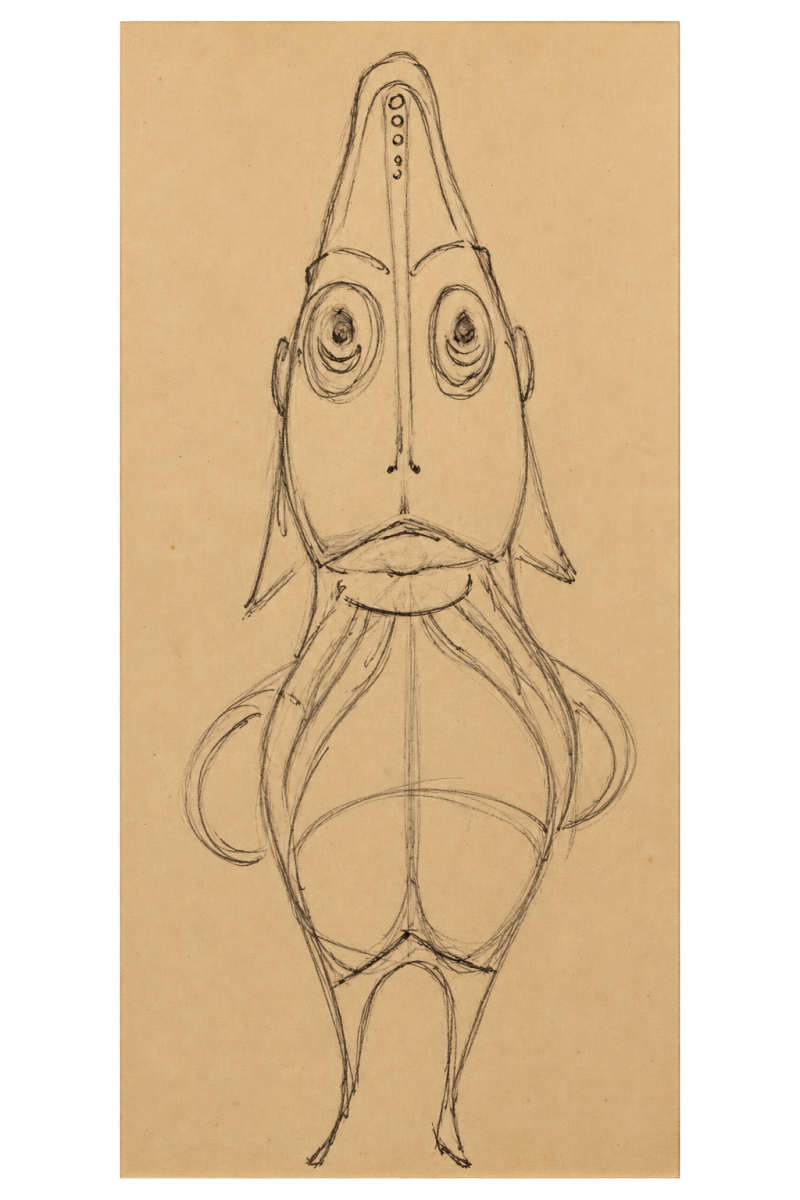
Etie van Rees — Before the Creatures Came to Life
A remarkable group of preparatory drawings offers a glimpse into the imagination behind one of the most distinctive figures in twentieth-century Dutch ceramics.
Etie van Rees (1890–1973) occupies a curious position in Dutch art. Today she is remembered primarily for the extraordinary ceramic creatures she began making relatively late in life: strange birds, hybrid animals and humorous beings inhabiting a world somewhere between nature, caricature and fantasy.
Yet long before Van Rees discovered clay, she was a draughtswoman.
Born Eelcoline Adrienne van Rees in Buitenzorg, Java, in 1890, she spent part of her youth in the Dutch East Indies before settling in the Netherlands. Apart from a period of instruction with the painter Bernard Schregel, she developed largely independently as an artist. Drawing, painting and printmaking formed the foundation of her artistic practice.
Her graphic work was by no means insignificant. Works by Van Rees entered the collection of the Rijksmuseum, and she was active as an illustrator and printmaker. In 1946 she published and illustrated her own children’s book, De Nachtmannetjes, populated by the kind of mysterious and animated beings that would later reappear in three dimensions.
Discovering clay at sixty-two
The decisive change came in 1952.
At the age of sixty-two, Van Rees began experimenting with clay. What initially seems to have been an almost accidental encounter with the material developed into the work for which she became best known.
Her animals were not conventional ceramic sculpture. They were hand-modelled individuals: birds, mice, owls and creatures for which zoology provides no adequate name. Van Rees herself referred to such beings as her kruipsels — roughly, “creeping creatures.”
The collector and ceramic specialist Jan van Achterbergh affectionately described this imaginary animal kingdom as the Bestiarum Reesianum.
Within only a few years Van Rees received considerable recognition. In 1959 she was awarded a gold medal at an international ceramics exhibition in Ostend. In 1964 Museum Boymans-Van Beuningen in Rotterdam presented the important exhibition Tussen mens en dier — Ceramiek van Etie van Rees (“Between Man and Animal”), which subsequently travelled to other Dutch museums.
What had begun as an experiment had become the defining achievement of her career.
Drawing the creatures before modelling them
An especially fascinating aspect of Van Rees’s working method is easily overlooked.
She drew her creatures before she made them.
Van Achterbergh, who knew her work intimately and was closely involved with the 1964 retrospective, recorded that Van Rees made detailed drawings for the figures she intended to execute in clay. Some designs could wait for years before finally being modelled.
Even more remarkably, he observed how closely she followed those drawings: small nuances conceived on paper were transferred into clay during modelling.
The drawing was therefore not merely an incidental sketch.
It was where the creature was born.
A recently brought-together group of approximately twenty drawings makes this creative process wonderfully visible. Birds are divided into decorative sections as though their feathers have already become areas of ceramic decoration. Cats acquire exaggerated faces. Familiar animals transform into imaginary species. Elsewhere, human, animal and object seem to merge completely.
Several sheets contain multiple studies, allowing us to see Van Rees searching for a silhouette, changing a head, exaggerating an eye or transforming the anatomy of an ordinary animal into something entirely her own.
Some are rapidly drawn in pencil; others are more elaborate and show patterns, ornament and construction in considerable detail.
Seen together, they resemble a private laboratory of ideas.
Between observation and imagination
The drawings also reveal something essential about Van Rees’s art.
She did not simply invent monsters.
Again and again, recognisable animals provide the starting point: a rooster, an owl, a duck, a dog, a rodent or a cat. Van Rees observes them and then gradually abandons naturalism.
Eyes become enormous. Beaks turn into masks. Bodies are divided into geometric fields. Feathers become ornament. Human expressions appear on animal faces.
The boundary between species becomes increasingly uncertain.
This transformation was already present in her earlier graphic art. A work such as De Aarde, now in the Rijksmuseum, shows a fantastical conception of nature populated by animals, birds, insects and extraordinary vegetation.
Her later ceramics did not suddenly introduce this imaginary world. Clay gave physical form to a world that had existed on paper for decades.
From Java to the Bestiarum Reesianum
There is another dimension to Van Rees’s visual language.
She spent her childhood on Java and returned there in 1938. Scholars have noted the possible influence of Javanese visual culture on aspects of the decoration of her ceramics.
One should be careful not to explain her highly individual imagery through a single source. Nevertheless, the masks, patterned surfaces and transformation of animals in both drawings and ceramics make her Indonesian background an intriguing aspect of further research.
Her work ultimately belongs to no simple category.
It can be humorous without becoming merely decorative, primitive in appearance while being remarkably sophisticated in conception, and fantastic without completely abandoning observation of the natural world.
The E. Bredius provenance
The history of the group adds another important layer.
An old handwritten inscription accompanying the drawings describes approximately twenty sheets as sketches for ceramics and connects them with Mrs E. Bredius of Aerdenhout. The inscription further indicates that the drawings had been received as a gift.
This name is significant.
Museum Boijmans Van Beuningen records a ceramic sculpture by Etie van Rees in its collection as a gift of Ms E. Bredius in 1977. The connection demonstrates that Bredius owned work by Van Rees and subsequently donated it to a major Dutch museum.
The drawings and their inscription therefore deserve to be considered in the context of a documented Van Rees collector closely associated with her work.
Further research into the precise history of the group is ongoing.
An artist worth looking at again
Etie van Rees died in Aerdenhout in 1973.
Her ceramics have never been entirely forgotten. A major retrospective, Het Louche Maliepaard en ander werk van Etie van Rees (1890–1973), was organised by the Princessehof in Leeuwarden in 1990, and examples of her work remain in Dutch museum collections.
Yet concentrating exclusively on the ceramics risks missing something fundamental.
The drawings show that the celebrated kruipsels were the culmination of a much longer artistic development. They reveal an artist who spent decades looking at nature and then reconstructing it according to the rules of her own imagination.
On paper, one can witness the precise moment at which an ordinary bird ceases to be a bird and becomes an Etie van Rees.
And perhaps that is the most compelling reason to look at her work again.
The creatures did not begin in clay. They began with a line.