The Life and Work of Barend Jordens
Barend Jordens (1888–1972) and the elegance of Dutch sculpture between the wars
Barend Jordens belongs to that fascinating generation of Dutch artists whose work stood at the intersection of sculpture, architecture and the applied arts. Born in Amsterdam in 1888, he trained at the Teekenschool voor Kunstambachten and subsequently at the Rijkschool voor Kunstnijverheid, studying under Willem Retera and August Falise. In 1923–24 he further developed his knowledge of ceramics under the influential ceramicist Bert Nienhuis.
Jordens was remarkably versatile. He worked as a sculptor, woodcarver, ceramicist, painter, medallist and designer, but sculpture remained central to his career. From 1919 until around 1950 he taught modelling and sculpture at the Kunstnijverheidsschool Quellinus in Amsterdam, later known as the Instituut voor Kunstnijverheidsonderwijs. In this position he influenced a younger generation of Dutch sculptors and craftsmen.
His name is also closely connected with the architecture of interwar Amsterdam. Jordens supplied architectural sculpture and decorative work for several buildings, most famously the celebrated Tuschinski Theatre, completed in 1921. He was also responsible for architectural sculpture for the Incasso Bank in Enschede. His standing was confirmed internationally in 1925, when he received a silver medal for sculpture at the Exposition Internationale des Arts Décoratifs et Industriels Modernes in Paris — the exhibition that would give Art Deco its name.
The Monkeys
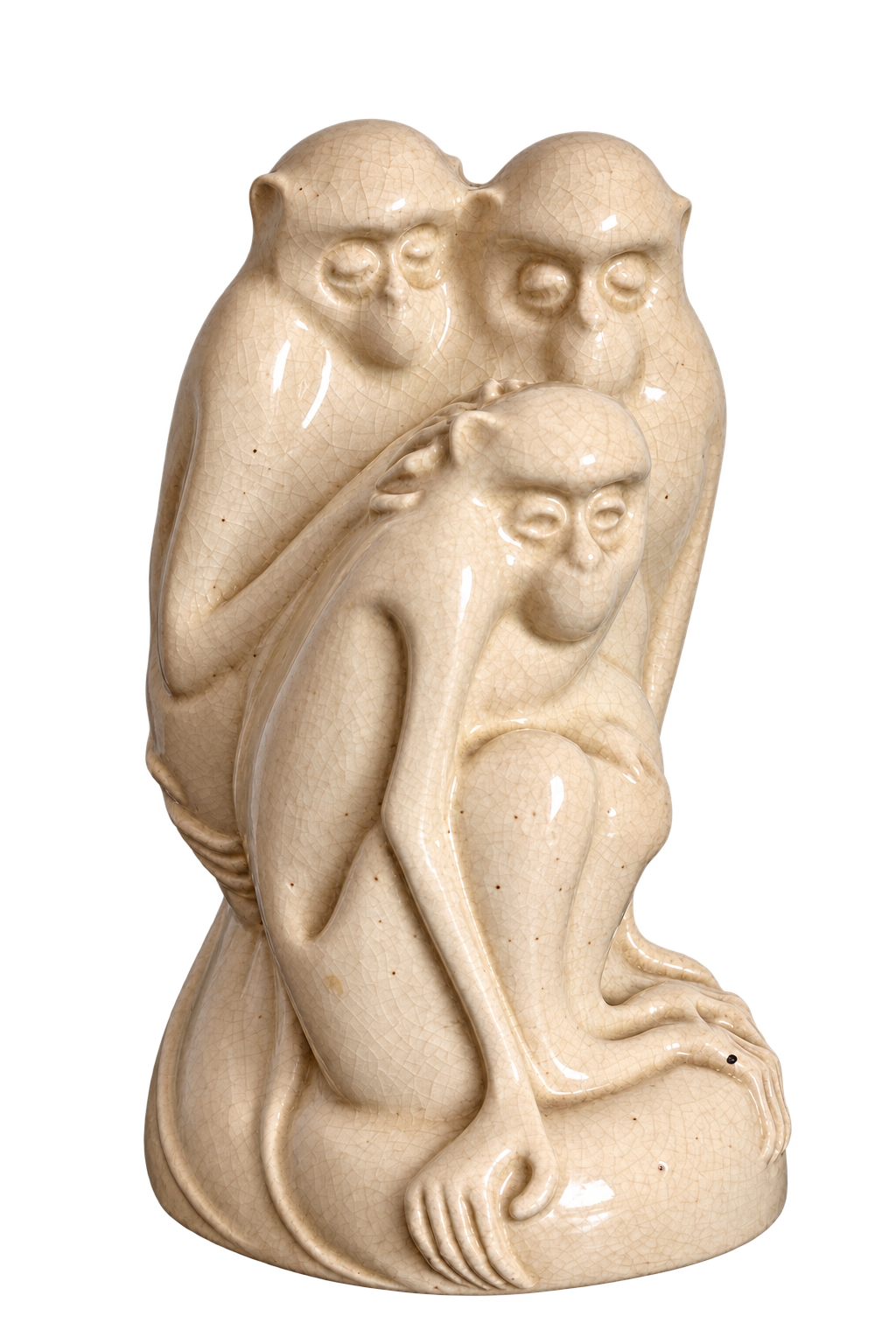
The ceramic sculpture illustrated here is particularly characteristic of Jordens’ fascination with animals. Three monkeys are compressed into a remarkably compact composition: the seated animal in front is framed by two companions rising immediately behind it.
The monochrome cream glaze gives the sculpture an almost ivory-like appearance, while the fine network of craquelure lends the surface considerable depth. Jordens reduced the anatomy to flowing volumes and strongly simplified faces, yet each animal retains its own expression and character. It is this balance between observation and stylisation that places the sculpture so convincingly within Dutch decorative art of the 1920s and 1930s.
Animals formed a recurring theme within Jordens’ oeuvre. A comparable sculptural treatment can be seen in another known work from the 1930s depicting a monkey with its young, demonstrating that the subject occupied him beyond a single composition.
What particularly appeals to me about this work is that it sits somewhere between fine art and decorative art. It is playful without becoming merely decorative and stylised without losing the character of the animals. That combination is very much of its period.
The sculpture recently left The Weyde Collection and was acquired by an enthusiastic private collector whose collection is devoted exclusively to art from the 1920s and 1930s. It is difficult to imagine a more appropriate destination for it.
Sometimes selling a work is not simply about finding a buyer, but about finding the collection in which it truly belongs.